
Artikel: The Caterer's Guide to Chafing Dish Wind Guards (Magnetic Acrylic vs Wire Cages)
The Caterer's Guide to Chafing Dish Wind Guards (Magnetic Acrylic vs Wire Cages)
Last updated: June 2026, now includes full wire cage vs magnetic acrylic head-to-head, buyer profiles, and FAQ.
Why this comparison matters
A caterer choosing between wire cage wind guards and magnetic acrylic wind guards is not choosing between a good option and a bad one. They are choosing between two different operational models, at two very different price points, for two different client bases.
Wire cage guards cost $15 to $40 each. Magnetic acrylic guards cost $230 to $260 per set. That gap is real and the decision should not be made on gut feel. The right choice depends on what type of events you run, how much your clients photograph the buffet, and whether consistent flame stability is a make-or-break concern at your typical venue.
This guide covers both options honestly: where each came from, what each actually does, and which caterer profile should pick which.
Wire cage wind guards: the profile
Where they came from
Wire cage guards originated in restaurant supply for institutional food service. Hotel kitchens, hospital cafeterias, and catering halls running high-volume breakfasts needed something cheap, stackable, and dishwasher-safe around their chafing dishes. Wire fit that use case. The cage is typically chrome-plated steel wire bent into a rectangular frame that wraps around the lower half of the chafing dish, leaving the top open to access the food.
That context matters, because restaurant kitchens have controlled airflow. The wire cage was designed for an indoor environment, not a courtyard wedding in June with a 12 mph wind off the water.
What wire cages are good at
Cost is the obvious one. At $15 to $40 per unit, a wire cage for a 10-station buffet runs $150 to $400. Replacement after damage is not painful. For operations running school catering, corporate box lunches, or casual office parties, this matters.
They also stack. Wire cages nest into each other and take up relatively little space in a catering van. After a 6-hour event, cleanup is fast: pull the cage off, wipe it down, stack it with the others.
And they hold up. Chrome-plated steel does not crack or scratch the way acrylic can. A wire cage dropped on a concrete loading dock is usually fine. A drop like that on an acrylic panel corner can chip it.
Where wire cages fall short
The mesh design, which is what makes wire cages cheap to manufacture, is also what limits their actual wind protection. Air moves through wire mesh. At outdoor venues with cross-breezes above 8 to 10 mph, sterno flames inside a wire cage flicker noticeably and can extinguish. This is not a theoretical issue. It is a common complaint from caterers who brought wire cages to outdoor weddings and spent the afternoon relighting burners.
There is also no heat retention benefit. An acrylic panel holds some warmth near the chafing dish by reducing air circulation. Wire does not. For long outdoor events where keeping food above 140°F matters for food safety compliance, this is a real consideration.
Aesthetically, wire cages look like restaurant equipment because they are restaurant equipment. They read as functional and industrial, which is fine in a hotel kitchen and out of place at a farm-to-table rehearsal dinner. Guests will see the cage. At events where the buffet table is photographed, wire cages appear in those photos.
Finally, storage is messier than it looks. Wire cages nest, but they also catch on each other. The corners bend over time. A bent cage no longer sits flush against the chafing dish, which creates gaps where wind enters.
Magnetic acrylic wind guards: the profile
The material
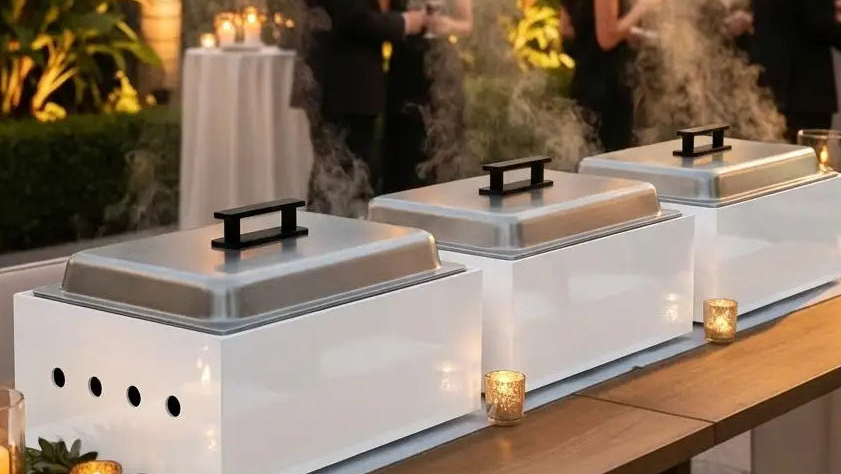
Magnetic acrylic wind guards are built from acrylic panels, typically 6mm thick, with embedded neodymium magnets at the corners and along the vertical seams. The panels form a closed rectangular enclosure around the chafing dish. Because the seams are magnetic rather than hinged or clipped, assembly is tool-free and takes under 30 seconds. You set the base, press the panels into place, and the magnets hold them together.
The panels are optically clear (or available in piano black or mirrored finishes), which means they disappear visually at the buffet table. Guests see the food and the chafing dish, not the wind protection hardware.
Wind and heat performance
Because the acrylic forms a solid perimeter rather than a mesh, wind cannot reach the sterno burner. Outdoor caterers who have switched from wire cages to acrylic report eliminating the flame-extinction problem entirely. The enclosure also creates a warmer microclimate around the dish. In practice, food temperatures inside an acrylic-enclosed chafing setup stay 5 to 10 degrees warmer than in an open or wire-caged setup under the same outdoor conditions, which matters for holding proteins at safe temperatures across a 3-hour reception.
Assembly and transport
Four panels disassemble by pulling any corner. The panels pack flat into a slim padded case. A set of four panels for a full-size chafing dish occupies about 2 inches of thickness in a transport case. For caterers who run multiple stations simultaneously, acrylic sets take up less van space per unit than wire cages that have bent and no longer nest cleanly.
Mitered 45-degree edges at the corners mean the acrylic set looks intentional when assembled. Butt-jointed acrylic (the cheaper version) leaves visible gaps at the corners that let air in and look less finished.
Durability caveat
Acrylic scratches. Over two to three years of active use, the panels accumulate fine scratches from stacking and transport unless stored in individual sleeves. The panels also chip at the corners if dropped on hard surfaces from above waist height. This is the main operational downside versus steel wire: the aesthetics degrade with rough handling.
Head-to-head comparison
| Factor | Wire cage | Magnetic acrylic |
|---|---|---|
| Unit cost | $15 to $40 | $230 to $260 per set |
| Wind protection (indoor) | Adequate for light HVAC airflow | Full seal, no airflow reaches flame |
| Wind protection (outdoor) | Poor above 8 mph cross-breeze | Consistent across all outdoor conditions |
| Heat retention | None | 5 to 10°F warmer microclimate |
| Aesthetic | Visible chrome wire, industrial | Clear or colored, nearly invisible |
| Assembly time | Slide over dish: 10 seconds | Snap 4 panels: 30 seconds |
| Disassembly after event | Lift off: 5 seconds | Pull corner, panels separate: 15 seconds |
| Transport | Nestable but can bend at corners | Pack-flat, slim padded case |
| Longevity | 3 to 5 years before visible corrosion or bent corners | 2 to 4 years before scratch accumulation, replaceable per panel |
| Replacement cost | $15 to $40 per unit | Individual panels replaceable without buying full set |
| Food photography impact | Wire visible in photos | Practically invisible in photos |
Which caterer profile picks which
Budget catering operations
Corporate lunches, school events, cafeteria-style company all-hands, funeral receptions. Indoor venues with controlled airflow. Client photographs the food for Slack, not Instagram. Wire cages are the right call. The $25 unit price matters when you are running 30 stations across 5 events per week and replacing units quarterly. Nobody is complaining about the wire.
Premium event catering
Weddings, galas, corporate dinners where a venue coordinator photographs the setup. Hotel banquet work where the client is paying $200 per head. Here, the buffet table is part of what the client bought. Wire cages show up in photos. When a bride's wedding photographer captures the cocktail-hour spread, the cages are in the frame. Acrylic guards disappear. This is the category where the $230 to $260 per-set cost makes sense operationally, not as a luxury, but as a cost of doing this type of event well.
Mobile and outdoor-heavy catering
Food trucks with buffet stations, outdoor festival catering, farmers-market pop-up service, park wedding receptions. If you are regularly setting up outdoors, wire cages are not a reliable choice above light breezes. Acrylic is not optional in these conditions, it is functional equipment. The flame-stability difference between wire and acrylic in a 15 mph coastal wind is the difference between a working station and a dead burner during service.
Hotel banquet departments
Hotel F&B teams running breakfast buffets 365 days a year in a climate-controlled ballroom are the one environment where wire cages genuinely make sense at scale. Volume is too high for acrylic to be practical across 50 stations, and the controlled environment removes the wind variable. The institutional origin of wire cages is showing here: this is the use case they were designed for.
Caterers who run both
Many mid-size catering operations own both. Wire for the Tuesday corporate lunch. Acrylic for the Saturday wedding. This is a reasonable split and avoids forcing a single purchasing decision to cover two very different operational realities.
Frequently asked questions
Do wire cage wind guards actually block wind?
Partially. Wire cage guards block direct horizontal gusts, but the open mesh allows air to pass through from multiple angles. In outdoor settings with sustained cross-breezes above 8 mph, flame stability with wire cages is noticeably worse than with solid acrylic panels. On an indoor buffet near an HVAC vent, either type will work, the wire cage just looks industrial.
Can magnetic acrylic wind guards handle outdoor summer events?
Yes. The 6mm acrylic panels form a closed perimeter when snapped together, which stops wind from reaching the sterno flame regardless of direction. Catering crews report stable flames at outdoor weddings where wire cages failed to hold the burner. The panels are UV-resistant and do not yellow in direct sunlight, though prolonged heat above 140°F near the burner face is worth monitoring for very long events.
How do magnetic acrylic guards store and transport compared to wire cages?
Wire cages nest together and take up roughly the same cubic volume per unit as a flat acrylic set. The difference is fragility: acrylic panels in a padded sleeve or case ship without denting or deforming. Wire cages can bend at the corners with repeated stacking, which loosens the fit around the chafing dish. The rectangular guard's four panels pack flat and slip into a slim padded case, fitting alongside chafing dishes in a catering van without occupying a separate crate. The round guard nests instead of packing flat.
Are magnetic acrylic wind guards worth the price difference over wire cages?
It depends on event type. For a caterer running casual corporate lunches where food presentation is secondary, a $25 wire cage does the job and the cost of replacement is low. For caterers working weddings, galas, hotel banquets, or any event where guests photograph the buffet table, the price difference ($25 wire vs $230 to $260 acrylic) pays back across 15 to 20 events in avoided client complaints and differentiated presentation. High-volume operations often run both: wire cages for low-stakes events, acrylic for premium bookings.
What size acrylic wind guard fits a full-size chafing dish?
A standard full-size chafing dish frame measures roughly 24 x 14 inches. The food pan inside it is 12 x 20 inches. Plinths New York (plinthsny.com)'s rectangular magnetic wind guard is sized to fit this footprint and similar brands including Vollrath, Winco, and Thunder Group. A separate round guard is available for round chafers. Its curved panels nest inside each other rather than packing flat. Always measure your specific chafing dish before ordering, the guard should sit flush against the dish frame, not overhanging the edges.
See Plinths New York's magnetic chafing dish wind guards
Related: For all-white setups specifically, see our full acrylic risers collection — white, black, clear, and mirrored finishes in matched-footprint sets.